The $1.2 Trillion Iceberg: MIT Study Quantifies AI's Hidden Job Disruption Across America
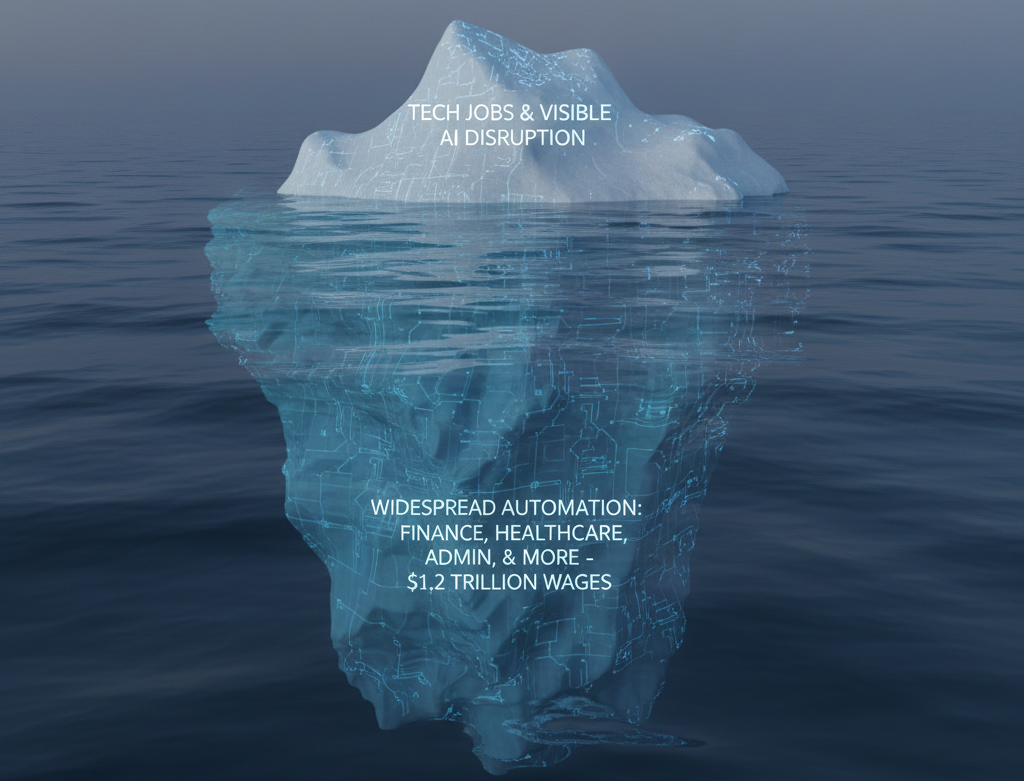
The narrative that AI-driven job disruption is confined to Silicon Valley coders has just been demolished by a staggering new study from the Massachusetts Institute of Technology (MIT). Using its advanced "Iceberg Index" simulation tool, MIT has quantified the true technical exposure of the US workforce to current AI capabilities.
The finding is a sober reality check for every major industry: AI can already perform tasks equivalent to 11.7% of the US workforce, representing a colossal $1.2 trillion in annual wages.
The Tip vs. The Mass: Beyond the Tech Bubble
The study's "Iceberg Index" metaphor is chillingly apt. The visible disruptions—the layoffs and role shifts in the tech and computing sectors—represent just the tip of the iceberg (around 2.2% of wage exposure).
The real threat lies beneath the surface, where AI's capabilities are quietly consuming routine cognitive tasks in massive sectors often overlooked in forecasts:
- Finance: Document parsing, routine analysis, and compliance review.
- Healthcare: Scheduling, claims processing, and administrative documentation.
- Professional Services: Routine functions in human resources, logistics, and office administration.
The study confirms that the impact is not confined to coastal tech hubs but is distributed across all 50 states, extending deep into inland and rural economies, especially those with large administrative footprints supporting manufacturing and logistics.
Capability vs. Replacement: The Critical Distinction
It's vital to note, as the researchers stress, that this 11.7% figure is a measure of technical capability, not an immediate layoff prediction. It means AI can do the work, at a cost equal to or less than human labor.
However, the fact that the capability exists now—and is already showing up as a 13% relative decline in early-career employment in AI-exposed roles—signals that the quiet reorganization of the workforce is accelerating faster than policy and education can currently adapt.
The message for business leaders and workers alike is unmistakable: The AI disruption is not a coming event; it is an unseen force that is already here, reshaping the foundational tasks of the entire economy.
Comments ()